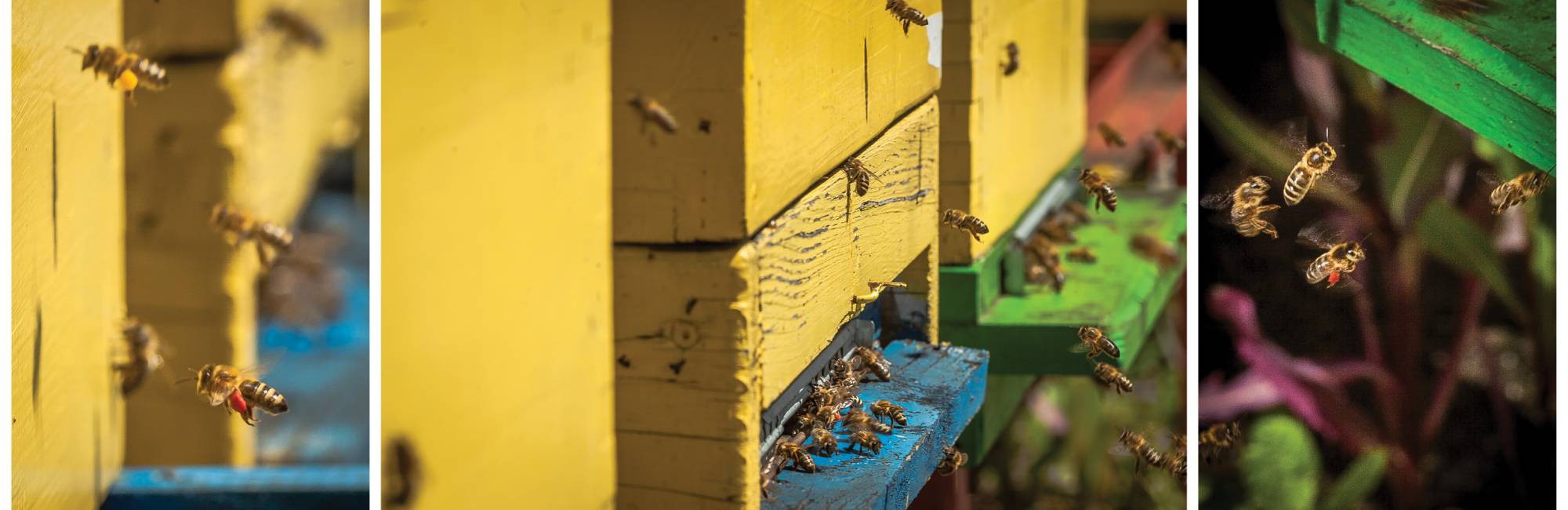
World Bee Day
Celebrating the 6th World Bee Day and the 13th Year of Urban Beekeeping at Cankarjev dom
As a pioneer of urban beekeeping in Slovenia, Cankarjev dom joins in the celebrations of the 8th World Bee Day (20 May), whose main purpose is to raise awareness of the importance of bees and other pollinators for humanity, food security, elimination of global hunger, environmental protection and biodiversity. Bees are pollinators of most plants and an important link to the natural balance and existence of life on Earth.
Urban beekeeping at Cankarjev dom was launched on 1 April 2011 when so-called stacking beehives were first installed on one of our cultural centre’s roof terraces on the initiative of Cankarjev dom’s employee Franc Petrovčič, a recipient of the Anton Janša Decoration (III and II Order). The quality of the honey made by bees on Cankarjev dom’s roof for over a decade is assessed and validated by a reference laboratory in Bremen where the honey is sent for an annual analysis. Cankarjev dom holds the Slovenian Beekeepers’ Association Certificate of Entry into the Register of Producers of Slovenian Honey with a Protected Designation of Origin (SMGO).
The annual honey harvest at CD depends on the number of bee families and the weather conditions when the flowers are in full bloom. Nevertheless, CD tends to produce 20 kilograms of honey per bee family each year. This spring, six families of Carniolan bees are buzzing in their beehives on our roof. While this year’s unpredictable spring weather, from severe heat to prolonged rain and lower temperatures, has impacted the development and yield of bee families, climate change has been radically affecting the development of bee families over a period of several years.
Cankarjev dom’s Programme on 8th World Bee Day, on Monday 19 May 2025
At 17.00
Guided Tour of Beehives on the Roof of Cankarjev dom
Conducted by Franci Petrovčič, CD beekeeper
Meeting point CD reception desk, entrance from Prešernova Street
Applications: zvezdana.lazar@cd-cc.si
Bees have been coexisting with culture on the roof of Cankarjev dom for thirteen years, making CD one of the first urban beekeepers in Slovenia. Cankarjev dom's honey is of high quality and has been certified as Slovenian honey with a protected geographical indication.
Cankarjev dom is a member of Ljubljana’s Bee Path, a project launched in 2015 and run by the Municipality of Ljubljana.
At 18.00
Nick Brandt
The Day May Break
Public guided tour of the exhibition
The Day May Break is a unique global photographic series that spotlights the devastating impact of climate change on people, animals and ecosystems.
CD Gallery EUR 5, 3'50*
(*visitors aged under 25, over 65 and pensioners)
At 19.00
Silvestres / Wilding
Portugal, 2024, 54'
Documentary film
Directed and produced by Carolina Castro Almeida and Miguel Cortes Costa
The screening will be followed by a talk with Blanka Ravnjak, PhD, from the University Botanic Gardens Ljubljana. The talk will be hosted by Damjan Vinter.
Kosovel Hall, free tickets
Educating the young audiences is one of Cankarjev dom’s prime focuses. Cankarjev dom is committed not only to presenting a first-rate arts and education programme, but also raising awareness about the importance of living in harmony with nature, preserving the environment and nature, sustainable development and mitigating adverse environmental impacts. Cankarjev dom fulfils this educational mission by organising environmental exhibitions and other events.
Urbani Čebelar Society and Ljubljana’s Bee Path
Cankarjev dom is a co-initiator of Urbani Čebelar (Urban Beekeeper), a society dedicated to raising awareness about bees, fostering apiculture and responsible urban beekeeping. Cankarjev dom is also a member of Ljubljana’s Bee Path, a project launched in 2015 by the Municipality of Ljubljana. The Path is managed by the City of Ljubljana through various activities (postponing mowing, and planting aromatic plants and herbs and native honey plants and trees) and the active involvement of its members. It is dedicated to the well-being of urban bees and raising awareness about the importance of bees in our ecosystem.
About the World Bee Day
In December 2017, the UN General Assembly accepted Slovenia’s proposal and declared 20 May as World Bee Day.
In 2014, the President of the Beekeeping Association of Slovenia, Boštjan Noč, proposed that the United Nations proclaim 20 May as World Bee Day.
On 20 December 2017, following three years of international efforts, the UN Member States unanimously approved Slovenia’s proposal and 20 May was proclaimed World Bee Day. In 2015, the initiative was unanimously supported in South Korea by the world beekeeping organisation Apimondia (International Federation of Beekeepers' Associations).
20 May is also the birthday of Anton Janša (1734–73), the most outstanding figure of Slovenian beekeeping and the pioneer of modern beekeeping. Anton Janša was the first beekeeping teacher at the Viennese imperial court of the Habsburg Empress Maria Theresa. In the 18th century, he completely revised the theretofore beekeeping methods based on his findings and laid the foundations of modern beekeeping. He gained renown for his work already during his lifetime. After 1775, all national beekeeping teachers had to employ his teaching methods.
Population of Bees and Other Pollinators Declining Drastically
Scientific studies conducted by the United Nations and the International Union for the Conservation of Nature have shown that there are more and more negative effects on the health of bees, which makes them increasingly endangered. This, in turn, requires us to take extra care of their survival, as harmful factors cause a decline in the resistance of bees, which affects their susceptibility to diseases, pests and the like. Bees are continually exposed to new diseases and pests, and their natural habitat has been shrinking due to the growing human population. Furthermore, the survival and development of bees and other pollinators are also increasingly affected by climate change. Bees need clean air, water and a clean environment.
Slovenia at the Top of the World in Number of Beekeepers per Capita
With five beekeepers per 1000 inhabitants, Slovenia ranks at the very top of the EU Member States in terms of the number of beekeepers per capita. Slovenians are a nation of beekeepers, and beekeeping enjoys a status equal to that of other types of agricultural practices. In Slovenia, awareness of the significance of bees and ensuring their well-being is therefore generally high. For tens of thousands of Slovenians, beekeeping is a way of life with a long tradition, and the bee, especially the autochthonous Carniolan bee, is part of the Slovenian national identity. As many as three percent of all Slovenian beekeepers, with more than 4500 hives, are located in the area of the City Municipality of Ljubljana. Slovenia is the first EU Member State that provided legal protection to bees. In 2011, Slovenia was one of the first countries in the EU to prohibit the use of certain pesticides most harmful to bees.
On 22 April 2024, at the European Beekeepers' Association EBA's Elective Assembly, the President of the Slovenian Beekeepers' Association, Boštjan Noč, was elected as the first President of the Slovenia-based European Beekeepers' Association. One of the objectives of EBA is to develop effective procedures to completely eliminate fake honey from the European market.
Bees play an important role in nature, ensuring the existence of humanity. Slovenians are well aware of their exceptional mission, which is why beekeeping is so strongly grounded in our tradition.
Cankarjev dom’s Sustainable Goals
Keenly aware of the importance of sustainable cities and communities, Cankarjev dom grows honey plants, keeps bees on its roof, and manages the green areas of the Council of Europe Park that boasts 230-year-old trees. As pollinators of three-quarters of the world’s crops, bees have several characteristics in common with the 2030 Agenda for Sustainable Development, which envisions a world free of hunger and an end to environmental degradation. The contribution of bee pollination in promoting sustainable development goals through food security and biodiversity is widely acknowledged.
Sustainability also at Micro Level
Striving to operate sustainably, we believe that important common goals can be achieved by taking small steps, which is why this year, for the first time, Cankarjev dom joined in the celebrations of World Earth Day, the largest global event aimed at raising awareness and taking action on key environmental issues, held this year under the slogan "Our Planet, Our Power". To mark this occasion, we held a plant exchange event for employees and distributed 1000 litres of compost to employees and visitors.
Cankarjev dom regularly organises a sustainable event for its employees, Cankarjeva izmenjevalnica (“Cankarjev dom Exchange Point”), where employees exchange useful old items, bit and pieces. Cankarjeva izmenjevalnica is a project based on fair exchange, promoting solidarity and respect for nature; it is a space for raising awareness about the importance of reuse, responsibility towards fellow human beings and the environment. Items that do not find a new owner are taken to the local reuse centre.
Cankarjev dom employees are encouraged to cycle to work. Cankarjev dom has joined the national initiative Polni zagona, organised by the Ministry of Environment, Climate and Energy, IPoP – Institute for Spatial Policies, the Urban Planning Institute of the Republic of Slovenia. Seeking to reduce the percentage of food waste, Cankarjev dom has come to an arrangement with its outsourced caterers, Jezeršek and Vivo catering, regarding leftover food at events. Leftovers are distributed among employees, guests and charity organisations (Karitas Ljubljana). Together, we are proving that events can also be organised in a "food conscious" way.

 2nd International Dance Festival Ballet Nights
" width="580" height="395">
2nd International Dance Festival Ballet Nights
" width="580" height="395">
Dedicated to Vaslav Nijinsky


Bodite med prvimi ...
... ki boste izvedeli, katere koncerte, predavanja, gledališka in plesna gostovanja in drugo pripravljamo v Cankarjevem domu.
Founder and main co-funder of Cankarjev dom’s Arts and Culture programme

